If you've ever gotten an official-looking statement from your insurance company and assumed it was a bill — you're not alone. That's one of the most common sources of confusion in healthcare billing, and it's also one of the most important things to sort out before you pay anything.
Your explanation of benefits (EOB) and your medical bill are two different documents that do two different things. Understanding the difference is the single best way to catch billing errors early.
What's an EOB?
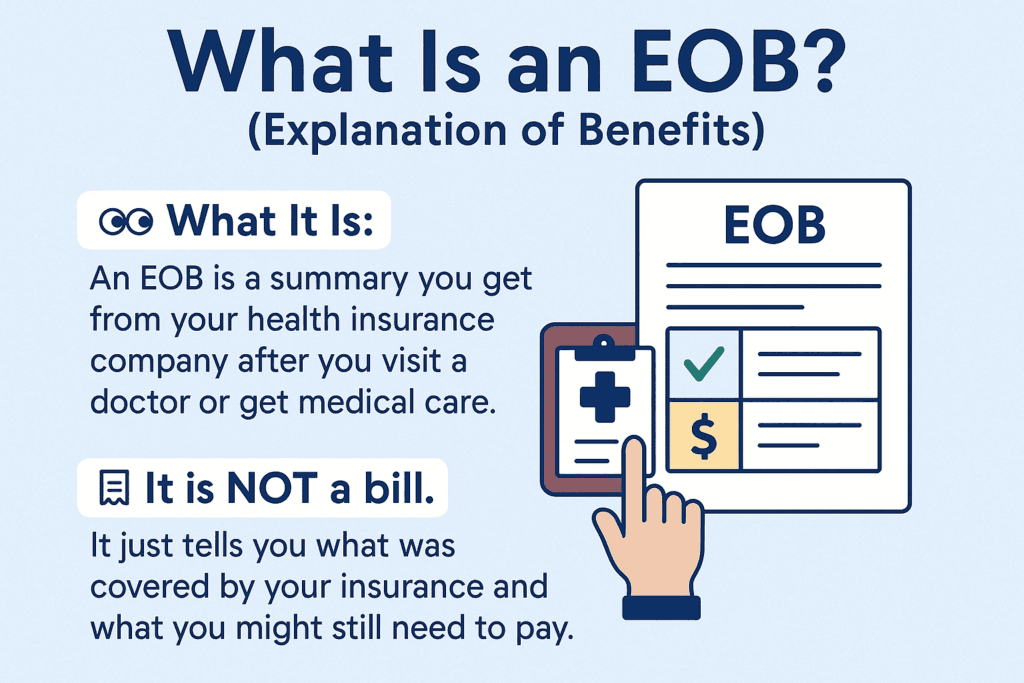
EOB stands for explanation of benefits. It's when your insurance company sends you a letter that explains the adjudication decision — basically, it's decided how much you're going to owe for a doctor's visit and how much the plan is going to owe.
An explanation of benefits (EOB) is a statement from your insurance company showing how they processed a claim. It breaks down:
What the provider charged
What your insurance agreed to pay
What you're responsible for
The line that matters most is labeled "patient responsibility" (or something similar). That's the number your insurance company has decided you actually owe.
What's a Medical Bill?
A medical bill is an actual payment request. It comes from your doctor's office, the hospital, or a lab — and it's asking you to pay a specific amount by a specific date.
The bill should arrive after the provider has received the EOB information from your insurance company, because they need to know how much insurance covered before they can bill you the rest.
That's the theory. In practice, bills and EOBs sometimes show up out of order — which is where errors start.
How to Use Your EOB to Check a Bill
When a bill arrives, compare the amount to the "patient responsibility" line on the matching EOB. Those two numbers should be the same. The number you really want to look at is where it says patient responsibility. So that's you — the patient. It's going to describe exactly how much they (insurance) have decided that you owe.
Here's what to do depending on what you see:
The bill matches your EOB
That's the right outcome. Pay it, keep records of both documents.
The bill is higher than your EOB says
Pause. Look at the bill and check whether it shows any insurance adjustments or payments.
If there are no insurance adjustments on the bill, your provider probably sent it before insurance finished processing the claim. This happens a lot with bigger hospital systems where billing runs on automated schedules. Wait for the corrected bill.
If the bill shows insurance adjustments but the numbers still don't match, call the billing office. There may be a coding error, a duplicate charge, or something that needs to be reconciled.
If that number is much higher than what you see on your insurance statement, don't pay it yet. Wait for the next bill.
The bill is lower than your EOB says
If they're billing you less than insurance says you should owe, take the win and move on. That does not happen too often — generally they're trying to bill you more.
With roughly 40% of medical bills containing errors, this EOB-to-bill comparison is one of the most effective ways to catch overcharges before you're on the hook for them.
How to Read EOB Line Items
Your EOB should break things down into line items — one for each service. Sometimes the descriptions are generic (you might just see "lab" instead of the specific tests), but the basic shape of the services should match what happened at your appointment.
You get an Explanation of Benefits listing 20 labs, you only had two done — that's your cue to start asking questions.
Check for:
Services you didn't receive
Services on dates you weren't there
Services that don't match your care — a procedure you didn't have, or a specialist you didn't see
If something looks wrong, call your hospital or doctor and ask them to walk you through the line items. You can also request more information on specific codes if the descriptions are too generic to make sense of.
When You Need an Itemized Bill
A regular medical bill won't give you much detail. It'll group services into broad categories — "emergency services," "lab," "radiology" — without showing you every individual charge.
If you're worried about the amount, ask the provider for an itemized bill. They have to break down every single service they're charging you for, which makes it much easier to spot errors or duplicate charges.
This matters most for hospital stays or ER visits, where you might have received hundreds of individual services. A standard bill will hide most of those details.
When EOBs Show Denials
Sometimes an EOB will show a denial or a large patient responsibility amount — especially after an ER visit — and it can be alarming. Before you panic, call the provider's billing office and ask where things stand.
In a lot of cases, the provider is still working with your insurance company to resolve authorization issues, and the EOB you're seeing reflects an in-progress state, not a final answer.
This is especially true for emergency care. Under federal law, ER visits generally have to be covered by your insurance without prior authorization, and authorization disputes for emergency care are usually the hospital's and insurer's problem to work out — not yours.
When You Need More Support
If the numbers on your bill and EOB don't match and you can't get a clear answer from the billing office, Granted reviews every line item to catch exactly these kinds of discrepancies. We check your bills against your EOBs and dispute charges that shouldn't be there. Free to start — you only pay if we save you money.
TL;DR
An EOB is your insurance company showing their math, not a bill
The "patient responsibility" line on your EOB is what you should actually owe
Compare your EOB to your medical bill — if the bill is higher, don't pay yet
If the bill is lower than your EOB says, pay it and move on
For hospital stays or ER visits, ask for an itemized bill to catch duplicate or phantom charges
Denials on EOBs aren't always final — call the provider's billing office to ask where things stand
Frequently Asked Questions
What's the difference between an EOB and a medical bill?
An EOB is a statement from your insurance company explaining how they processed your claim. A medical bill is an actual payment request from your provider. An EOB is not something you pay.
Which number on my EOB should I compare to my provider bill?
Look for the "patient responsibility" line. That's what your insurance says you owe, and it should match the bill from your provider.
What should I do if my provider bill is higher than my EOB patient responsibility?
Don't pay yet. Check the bill for insurance adjustments — if there aren't any, the provider likely billed you before insurance finished processing. Wait for the corrected bill or call the billing office to ask what's going on.
When should I request an itemized bill from my provider?
Any time the total seems higher than expected, especially for hospital stays or ER visits. Itemized bills break out every individual service and make errors much easier to catch.