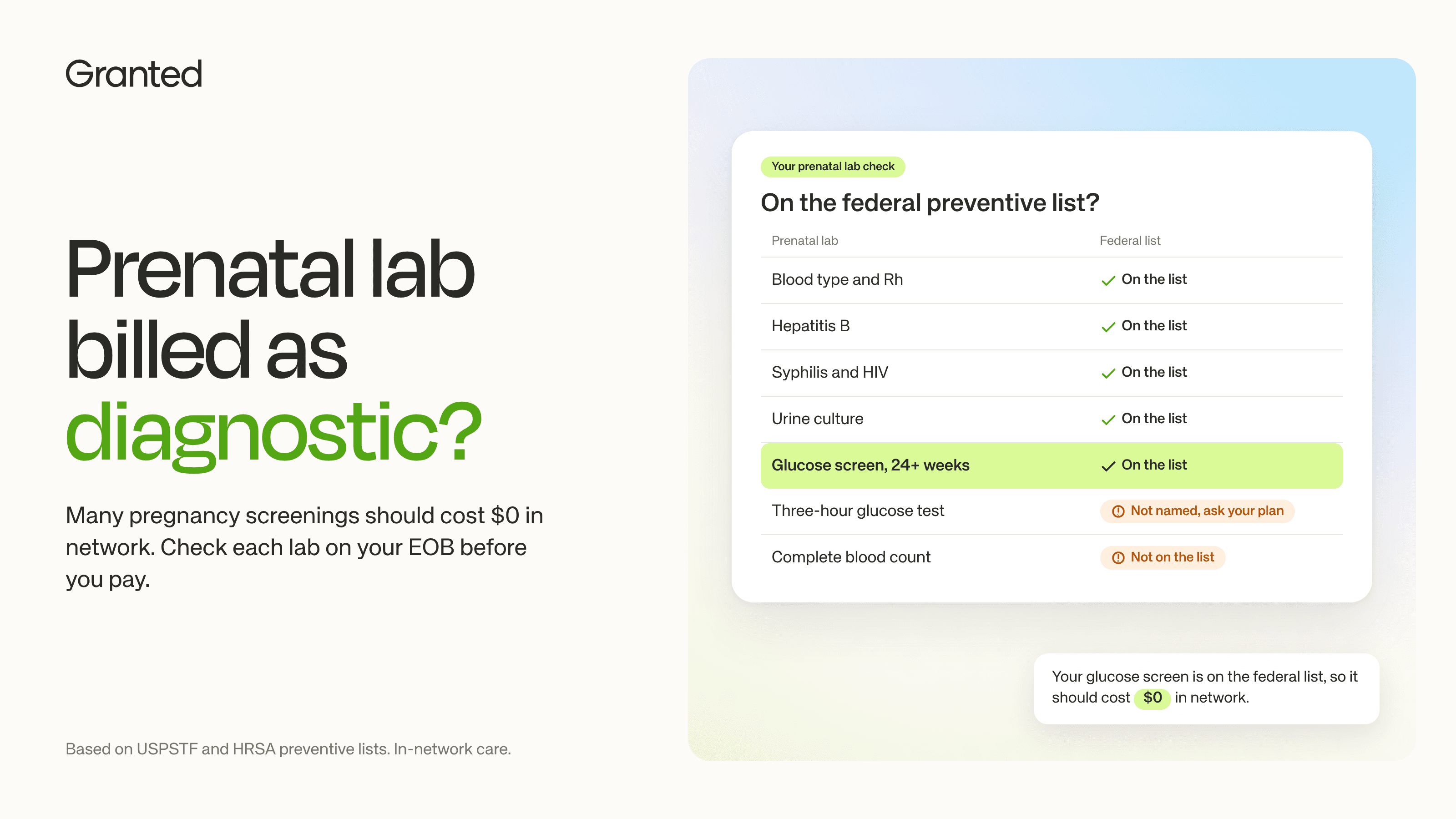
Short answer: If a routine prenatal screening was billed as diagnostic, you may be paying for a test that should have cost you $0. Most health plans must fully cover screenings like the gestational diabetes test at 24 weeks or later, hepatitis B, syphilis, HIV, and blood type and Rh testing when you use an in-network provider. If one of these shows a charge on your EOB, a billing code is usually the cause, and the office that ordered the test can send a corrected claim.
Key takeaways
A preventive prenatal lab often gets billed as diagnostic because of the diagnosis code on the order, so the ordering office is usually the one that can send a corrected claim.
As of 2026, most health plans must cover certain preventive screenings at no cost to you when you use an in-network provider.
Prenatal screenings on the federal preventive list in 2026 include blood type and Rh testing, hepatitis B, syphilis, HIV, hepatitis C, a urine culture, and the gestational diabetes screen at 24 weeks or later.
Anemia screening in pregnancy is not on the federal preventive list. In August 2024, the USPSTF again found too little evidence to recommend routine screening.
If a health plan denies a corrected prenatal lab claim, you generally have 180 days to file an internal appeal and 4 months after a final denial to request an external review.
In this guide
See which prenatal labs are on the federal preventive list
Learn how a preventive lab ends up billed as diagnostic
Spot preventive vs diagnostic billing problems on your EOB
Ask the ordering office for a corrected claim, or appeal if your plan says no
What does it mean when a prenatal lab is billed as diagnostic?
If the test is on the federal preventive list, it means you're paying for something that should have cost you $0, and that the bill may count toward your deductible when it shouldn't.
The difference comes down to why the test was done.
Preventive care catches problems early in people who feel fine, and listed screenings have no copay, coinsurance, or deductible in network.
Diagnostic care looks for the cause of a symptom or follows up on a known problem, and you usually pay part of the cost.
You'll spot it on your EOB (explanation of benefits), the statement your insurer sends after it processes a claim: look for "applied to deductible" or coinsurance on a routine screening. An EOB is not a bill. Our EOB vs. medical bill guide shows how to read them side by side.
Which prenatal screenings are preventive and should be free under federal rules?
These prenatal services must be covered at 100% when you use an in-network provider. Your plan has to pay in full: it can't apply the cost to your deductible, charge a copay, or bill you coinsurance. The Affordable Care Act (ACA) requires this under 45 CFR 147.130 for services with an A or B grade from the U.S. Preventive Services Task Force (USPSTF) and services in the HRSA Women's Preventive Services Guidelines.
1. Diabetes and blood type screenings
Gestational diabetes screening: after 24 weeks, usually between 24 and 28 weeks. It's covered earlier if you have risk factors. (USPSTF, HRSA)
Rh(D) incompatibility screening: blood typing and antibody testing at your first prenatal visit. A repeat antibody test at 24 to 28 weeks is covered if you're Rh-negative and not sensitized. (USPSTF)
2. Infectious disease screenings
Syphilis: at your first prenatal visit or as early in pregnancy as possible. (USPSTF)
Hepatitis B: at your first prenatal visit, in every pregnancy, even if you've been vaccinated or tested before. (USPSTF)
Hepatitis C: for adults 18 to 79, including pregnant adults. (USPSTF)
HIV: when you start prenatal care. A rapid HIV test during labor is also covered if your HIV status isn't documented. (USPSTF, HRSA)
Chlamydia and gonorrhea: if you're 24 or younger, or older and at increased risk. (USPSTF)
Urine culture for bacteria: at 12 to 16 weeks, or at your first prenatal visit if it's later. (USPSTF)
3. Blood pressure and physical checks
Preeclampsia screening: a blood pressure check at every prenatal visit, throughout pregnancy. (USPSTF)
Urinary incontinence screening: once a year, including during pregnancy and after birth. (HRSA)
4. Mental health and behavioral screenings
Depression and anxiety screening: during pregnancy and after birth. (USPSTF, HRSA)
Intimate partner violence screening: at least once a year, with counseling or referral if you need it. (HRSA)
Tobacco use: screening, plus expanded counseling to help you quit. (HealthCare.gov)
Alcohol and drug use: screening, plus brief counseling if needed. (USPSTF alcohol, USPSTF drug use)
5. Preventive medications
Low-dose aspirin: to help prevent preeclampsia, started after 12 weeks if you're at high risk. (USPSTF)
Folic acid: 0.4 to 0.8 mg a day for anyone planning or able to become pregnant, to help prevent neural tube defects. (HealthCare.gov)
If any of these shows a deductible, copay, or coinsurance on your EOB, it may have been billed as diagnostic.
These rules don't apply to grandfathered plans, plans bought or created on or before March 23, 2010 that haven't changed since. In September 2026, the federal health secretary named eight new task force members, Medical Economics reported. No prenatal grade had changed as of October 23, 2026, and a plan that covers a service at the start of a plan year generally keeps covering it through that year.
Prenatal tests that may or may not be covered
Your plan decides whether you pay for these tests, because they aren't on the federal preventive list. Many plans cover them as part of prenatal care, but they can count toward your deductible. Check your plan's maternity benefits or call your insurer before the test.
Three-hour glucose tolerance test: the follow-up if your one-hour glucose screen comes back high. Federal rules don't name it, so some plans count it as part of the covered screen and others bill it as diagnostic. Ask your plan which one applies.
Complete blood count (anemia screen): in August 2024, the USPSTF found too little evidence to recommend routine anemia screening in pregnancy, so it's not on the federal list. Many plans still cover it as part of routine prenatal care. (USPSTF)
Rubella immunity test: a blood test that checks whether you're protected against rubella (German measles). It isn't on the USPSTF or HRSA lists.
Group B strep test: a swab, usually late in pregnancy, that checks for bacteria that can pass to your baby during birth. It isn't on either federal list.
NIPT (noninvasive prenatal testing): a blood test that screens for certain chromosome conditions. Coverage and what you owe vary by plan.
Carrier screening: a test that checks whether you carry genes for certain inherited conditions. It isn't on either federal list.
What is on a prenatal lab bill?
Expect several bills from one prenatal visit, and they can arrive weeks apart. Here's who may bill you and what to check on each:
Visit and blood draw: from your OB or midwife's office. Look for a separate visit charge, which federal rules allow in some cases.
In-house or hospital lab: for tests run on site. Check network status and the diagnosis code on each line.
Outside reference lab: a separate lab company your sample was sent to. Check that it's in your network.
Genetic testing lab: a specialty lab for NIPT or carrier screening. Check your plan's coverage and the lab's network status.
EOB for each claim: from your insurer, showing what your plan paid and what you owe. Look for deductible, coinsurance, or "not preventive" notes.
How does a preventive prenatal lab get billed as diagnostic?
Usually, the diagnosis code on the claim is wrong. Each claim has two codes: a CPT code names the test, and an ICD-10 diagnosis code says why you had it. If the diagnosis code points to a symptom or problem, your plan processes the test as diagnostic.
Wrong diagnosis code. Routine prenatal visits are usually coded Z34, "encounter for supervision of normal pregnancy," per the ICD-10-CM code listing. A symptom or complication code can turn a routine screen into a diagnostic test.
Missing preventive modifier. Modifier 33, added to the CPT code, tells your plan the service was preventive. Some plans require it.
Mistake on the order. Labs bill with the diagnosis code on your OB's order, so a wrong code on the order ends up on the lab's claim too.
Some diagnostic billing is correct. A test ordered because of a symptom or an earlier result can be diagnostic. An out-of-network lab can also charge you, since the rule only covers in-network care.
Common errors on prenatal lab bills
Look for these six errors:
Routine screen coded as a problem. Spot it: your EOB applies the deductible to a test from the federal list above, and you had no symptoms. Ask for the itemized bill to see the diagnosis code.
Preventive marker missing. Spot it: the EOB shows coinsurance on a listed screening, and the itemized bill shows no preventive modifier.
Sample sent to an out-of-network lab. Spot it: the EOB marks the lab "out-of-network," even though your OB is in network.
Same test billed twice. Spot it: the same CPT code and date appear on the office bill and the lab bill.
Test you did not have. Spot it: a test name on the itemized bill does not match what you were told. For example, a three-hour glucose test appears when you had only the one-hour screen.
Bill sent before the claim finished. Spot it: the bill says "insurance pending," or you have no matching EOB yet.
Industry research finds 8 of 10 medical bills contain errors, and Granted can help you check.
How to check a prenatal lab billed as diagnostic and ask for a fix
Wait for the EOB before you pay. Match each lab bill to its EOB line by date and test name.
Find each lab line on the EOB. Look for "applied to deductible," coinsurance, or a note that the service is not covered as preventive.
Compare each charged test with the federal list above. If a listed screening shows cost sharing, mark it.
Ask the lab or office for an itemized bill with CPT and diagnosis codes. Our guide on requesting an itemized bill explains how.
Call your insurer. Ask whether the line was processed under preventive benefits and, if not, why. Write down the date and a call reference number.
Call the ordering office's billing team. If the code doesn't match a routine visit, ask them to send your plan a corrected claim, or send the lab a corrected order if the lab billed you. Ask the lab to pause the bill in the meantime.
Appeal if your plan says no. You generally have 180 days from the denial to file an internal appeal, per HealthCare.gov. If the plan still says no, you have 4 months to ask for an external review by an independent reviewer.
If your plan denies the claim, our 48-hour plan for a denied claim walks through the first steps.
Script: asking the ordering office for a corrected claim
Granted can help you ask the office that billed you to correct it if we find errors.
If you would rather ask the office yourself, you can say:
"Hi, I'm calling about a lab bill from my prenatal visit on [date]. My EOB shows the [test name] was processed as diagnostic, and I was charged [amount]. This is a routine prenatal screening on the federal preventive list. Can you check the diagnosis code on the order? If it should be a routine prenatal code, can you send a corrected claim, or a corrected order to the lab? Can you tell me when it will be sent and who I should follow up with?"
Do prenatal billing codes change in 2027?
Yes. Starting January 1, 2027, new maternity care codes from the American Medical Association (AMA) replace the global OB package, the single charge for routine prenatal care, delivery, and care after birth. Our upcoming guide Pregnancy Bills in 2027 covers that change.
How Granted can help with a prenatal lab bill
We review your prenatal lab bills and EOBs side by side. We check each lab line against the federal preventive list and your plan's rules, and look for coding errors, duplicate tests, and out-of-network labs. If a line looks wrong, we contact the ordering office, the lab, and your insurer to get it corrected.
Have a bill like this? Upload it before you pay. Free to start. You only pay if we lower your bill. Check your bill
Frequently asked questions about prenatal labs billed as diagnostic
Is the glucose test free during pregnancy?
Yes, the one-hour glucose screen at 24 weeks or later is free in network for most plans. It's a USPSTF B recommendation, and HRSA also covers earlier screening if you have risk factors. The three-hour follow-up test isn't named in federal rules, so you may owe part of its cost.
Why was my prenatal bloodwork applied to my deductible?
Usually because your plan processed it as diagnostic, or the test isn't on the preventive list. The most common causes are a diagnosis code for a symptom, a missing preventive modifier, or an out-of-network lab. Some tests, like a complete blood count, aren't on the federal list, so your plan's own policy decides.
What is the difference between preventive vs diagnostic billing?
The difference is why the test was done. Preventive billing is for routine screening when you have no symptoms, and listed screenings cost $0 in network. Diagnostic billing is for finding the cause of a symptom or following up on a known problem, and it usually counts toward your deductible and coinsurance.
Is anemia screening during pregnancy covered as preventive?
No. Anemia screening during pregnancy isn't on the federal preventive list. As of August 2024, the USPSTF found too little evidence to recommend for or against routine screening. Many plans still cover a complete blood count as part of prenatal care, so check your plan's prenatal policy. Granted can help you understand your plan benefits. Open a case and ask.
Can my doctor's office change a diagnosis code after I get the bill?
Yes. If the diagnosis code was wrong, the office can fix it and send your plan a corrected claim. If the test was ordered for a symptom, a diagnostic code may be correct. Ask as soon as you can, because plans set deadlines for corrected claims.
What does Granted charge to help with a prenatal lab bill?
It's free to start, and you only pay if we lower your bill. Our fee is 10% of the negotiated savings, capped at $300 per bill. Granted is a digital health advocate: we review medical bills, find billing errors, negotiate with billing offices, and check whether you qualify for income based discounts.
Key terms in this post
Preventive care: routine screening for people without symptoms, meant to catch problems early.
Diagnostic care: tests or care to find the cause of a symptom or follow up on a known problem.
Explanation of benefits (EOB): the statement your insurer sends after it processes a claim; it is not a bill.
USPSTF: the U.S. Preventive Services Task Force, a federal expert panel whose A and B grades set which screenings plans must cover at no cost.
Diagnosis code (ICD-10): the code on a claim that tells your plan why you had a test.
Modifier 33: a code added to a billing code to show a service was preventive.
Grandfathered plan: a plan bought or created on or before March 23, 2010 that has not changed much and does not have to follow the preventive care rule.
Sources & More information
eCFR, 45 CFR 147.130, Coverage of preventive health services: https://www.ecfr.gov/current/title-45/subtitle-A/subchapter-B/part-147/section-147.130 (checked Oct 23, 2026)
HRSA, Women's Preventive Services Guidelines: https://www.hrsa.gov/womens-guidelines (checked Oct 23, 2026)
HealthCare.gov, Preventive care benefits for women: https://www.healthcare.gov/preventive-care-women/ (checked Oct 23, 2026)
HealthCare.gov, Preventive care benefits: https://www.healthcare.gov/coverage/preventive-care-benefits/ (checked Oct 23, 2026)
USPSTF, Rh(D) incompatibility screening (2004): https://www.uspreventiveservicestaskforce.org/uspstf/recommendation/rh-d-incompatibility-screening (checked Oct 23, 2026)
USPSTF, Hepatitis B screening in pregnancy (2019): https://www.uspreventiveservicestaskforce.org/uspstf/recommendation/hepatitis-b-virus-infection-in-pregnant-women-screening (checked Oct 23, 2026)
USPSTF, Syphilis screening during pregnancy (2025): https://www.uspreventiveservicestaskforce.org/uspstf/recommendation/syphilis-infection-in-pregnancy-screening (checked Oct 23, 2026)
USPSTF, HIV screening (2019): https://www.uspreventiveservicestaskforce.org/uspstf/recommendation/human-immunodeficiency-virus-hiv-infection-screening (checked Oct 23, 2026)
USPSTF, Hepatitis C screening (2020): https://www.uspreventiveservicestaskforce.org/uspstf/recommendation/hepatitis-c-screening (checked Oct 23, 2026)
USPSTF, Chlamydia and gonorrhea screening (2021): https://www.uspreventiveservicestaskforce.org/uspstf/recommendation/chlamydia-and-gonorrhea-screening (checked Oct 23, 2026)
USPSTF, Asymptomatic bacteriuria screening (2019): https://www.uspreventiveservicestaskforce.org/uspstf/recommendation/asymptomatic-bacteriuria-in-adults-screening (checked Oct 23, 2026)
USPSTF, Gestational diabetes screening (2021): https://www.uspreventiveservicestaskforce.org/uspstf/recommendation/gestational-diabetes-screening (checked Oct 23, 2026)
USPSTF, Iron deficiency anemia during pregnancy (2024): https://www.uspreventiveservicestaskforce.org/uspstf/recommendation/iron-deficiency-anemia-in-pregnant-women-screening-and-supplementation (checked Oct 23, 2026)
HealthCare.gov, Grandfathered health plan: https://www.healthcare.gov/glossary/grandfathered-health-plan/ (checked Oct 23, 2026)
HealthCare.gov, Internal appeals: https://www.healthcare.gov/appeal-insurance-company-decision/internal-appeals/ (checked Oct 23, 2026)
HealthCare.gov, External review: https://www.healthcare.gov/appeal-insurance-company-decision/external-review/ (checked Oct 23, 2026)
CoverME.gov, Maternal health: preventive vs diagnostic care: https://www.coverme.gov/sites/default/files/documents/Maternal%20Health%20-%20Preventive%20vs%20Diagnostic%20Final.pdf (checked Oct 23, 2026)
AAPC, ICD-10-CM code Z34: https://www.aapc.com/codes/icd-10-codes/Z34 (checked Oct 23, 2026)
California Medical Association, Using modifier 33 for preventive care: https://cmadocs.org/newsroom/news/view/ArticleId/38483/Coding-Corner-Using-modifier-33-for-preventive-care (checked Oct 23, 2026)
Medical Economics, USPSTF roster adds new members, Sept 17, 2026: https://www.medicaleconomics.com/view/us-preventive-services-task-force-roster-adds-new-cardiologists-radiologist-health-economist (checked Oct 23, 2026)
Contemporary OB/GYN, AMA and ACOG announce maternity coding changes for 2027, Apr 23, 2026: https://www.contemporaryobgyn.net/view/ama-acog-announce-restructuring-of-maternity-care-coding-for-2027 (checked Oct 23, 2026)
If you have a bill like this
Upload it and we will review every charge, look for opportunities to lower what you owe, and handle the work with you. Free to start. You only pay if we lower your bill.
Connect your insurance, too. We connect to 1,300+ insurers and patient portals, so we can see your bills and claims together and keep an eye on them between visits.
Each bill is different, and results vary.
This is general information, not legal or tax advice.